Unlike most Italians, I did not grow up drinking coffee. I somehow made it all the way to adulthood without developing a dependence on espresso, only to discover it during my first year of university, at precisely the moment when I needed to reconsider my entire approach to life.
Until then, my strategy had been quite simple: put in the absolute minimum amount of effort, wing everything else, and still expect the maximum possible outcome. This had worked suspiciously well throughout school, which I interpreted as evidence of my brilliance rather than an indication that school had perhaps not been difficult enough. University corrected that misunderstanding rather quickly.
As the lectures became harder, the nights became longer, and the exams started demanding actual preparation, coffee entered my life. At first it was purely functional: a small, bitter dose of borrowed energy that made it possible to stare at equations for a few more hours. I soon became obsessed with espresso, though, and not just as a means of surviving thermodynamics.
This was an obsession that my late grandmother shared. She eventually gifted me her automatic coffee machine, which accompanied me throughout my university years. It was convenient, dependable, and able to produce coffee at the press of a button, which was exactly the level of effort I was willing to dedicate to the process at the time. I have very fond memories of that machine, not because the coffee was particularly good, as I would discover much later, but because it was hers before it was mine, and because it fuelled so many important years of my life.
For a long time, that was coffee to me: espresso, made from whatever dark-roasted beans happened to be available, extracted by a machine that asked very few questions. Being Italian, I naturally assumed that I already knew everything worth knowing about the subject.
I was wrong, of course.
Discovering that coffee can taste like coffee
Things started to change when I moved to the Netherlands. Through friends and colleagues, I discovered a vibrant coffee culture that was quite different from the one I had grown up around. Coffee was not limited to a quick shot swallowed at the counter of a bar. People talked about farms, processing methods, roast profiles and extraction. More confusingly, they described coffee using words such as floral, fruity and sweet, none of which matched the half-burnt, cheap Robusta mixes I associated with the drink.
I was intrigued. This was also when I discovered specialty coffee and started watching the videos of James Hoffmann, the Supreme Guru of coffee. As with every healthy interest of mine, the casual curiosity quickly turned into hours of research, increasingly specific equipment, and strong opinions that no reasonable person had asked for.
The most important realization was that coffee could have an extraordinary range of flavours. A light-roasted Ethiopian coffee could taste bright, delicate and almost tea-like; another coffee could remind you of chocolate or nuts without anyone having added flavouring to it. The bitterness I had always considered an unavoidable property of coffee was often just the result of dark roasting, poor beans, or bad preparation.
It felt a little like spending your whole life drinking boxed wine and then discovering that vineyards exist.
I started experimenting with pour-over coffee and the AeroPress, learning that different brewers could highlight completely different aspects of the same beans. I enjoyed both, and still do, but espresso remained my main addiction. There is something uniquely satisfying about compressing so much flavour into such a small drink—not to mention the fact that it arrives quickly, which appeals greatly to my lack of patience.
The automatic-machine crisis
Unfortunately, learning what good coffee tasted like had an unintended side effect: the coffee coming out of my rather new Philips automatic machine started to taste increasingly like dirty water.
The machine itself had not changed. I had.
This is the great danger of developing taste in any field. Ignorance is convenient and surprisingly cheap; knowledge has a tendency to ruin perfectly functional things and replace them with expensive hobbies.
After a considerable amount of research, I decided to take the plunge and bought a Sage Bambino, paired with a dedicated Varia VS3 grinder. Compared with an automatic machine, this was an entirely different workflow. I had to weigh the beans, grind them, distribute the grounds, tamp them, pull the shot, inspect the result, change a variable and try again. Instead of pressing one button and receiving a mediocre coffee, I could now perform a small chemistry experiment and occasionally receive a mediocre coffee.
But when everything came together, the result was in a different league.
This was when I properly learned about dialing in espresso: adjusting the grind size and dose to control how quickly water passes through the coffee, then tasting the result and repeating the process until the extraction is balanced. Too fast and the espresso can be thin and sour; too slow and it can become harsh and bitter. Somewhere between the two lies the sweet spot, which naturally moves every time you buy new beans, the weather changes, or the coffee gods decide that you have become too confident.
Learning to make a proper cappuccino
The Bambino also introduced me to steaming milk properly. Until then, a cappuccino was simply espresso plus hot, foamy milk. I gradually learned to create microfoam: glossy milk with bubbles so small that it pours almost like wet paint, integrates with the espresso, and has a wonderfully smooth texture.
Then came latte art.
At first, every attempt produced something that looked less like a heart and more like an anatomical warning sign. With enough practice, though, I learned to pour reasonably consistent hearts, tulips and the occasional rosetta. Latte art does not necessarily make the coffee taste better, but it is a good indicator that the milk texture is right—and, perhaps more importantly, it makes breakfast feel like a small achievement before the day has properly started.
Roughly around the same time, I stopped enjoying whatever excuse for a cappuccino I was served in most cafés in Italy. The country that had built so much of its identity around espresso suddenly seemed oddly complacent about it: beans roasted beyond recognition, shots extracted without much care, and milk transformed into a mountain of dry foam sitting on top of the coffee like insulating material.
Italy gave the world espresso culture, but in many places the coffee itself seems to have stopped evolving. Tradition is a wonderful thing, right until it becomes an excuse not to improve.
The inevitable gadget phase
Once you start making espresso at home, there is a predictable moment when you begin to suspect that every problem can be solved by buying a small piece of metal.
I experimented with WDT tools, used to break up clumps and distribute coffee evenly in the basket—including some extremely cool 3D-printed spirographic versions. Then came self-levelling tampers, distributors, precision baskets, bottomless portafilters, puck screens, dosing funnels and an assortment of other accessories whose combined purpose was to make a simple drink more repeatable by making the workflow considerably less simple.
To be fair, many of these tools were useful. A good grinder, accurate scales and proper puck preparation make a noticeable difference. A bottomless portafilter is also an excellent diagnostic tool, as it lets you see whether the espresso is extracting evenly. It is equally effective at spraying coffee across your kitchen whenever it is not.
But there is a point of diminishing returns. The more elaborate my preparation became, the more I realized that the perfect workflow is not the one with the largest number of carefully optimized steps. It is the one that produces excellent coffee consistently, without making you resent the process by the third cup.
From maximum tinkering to minimum mess
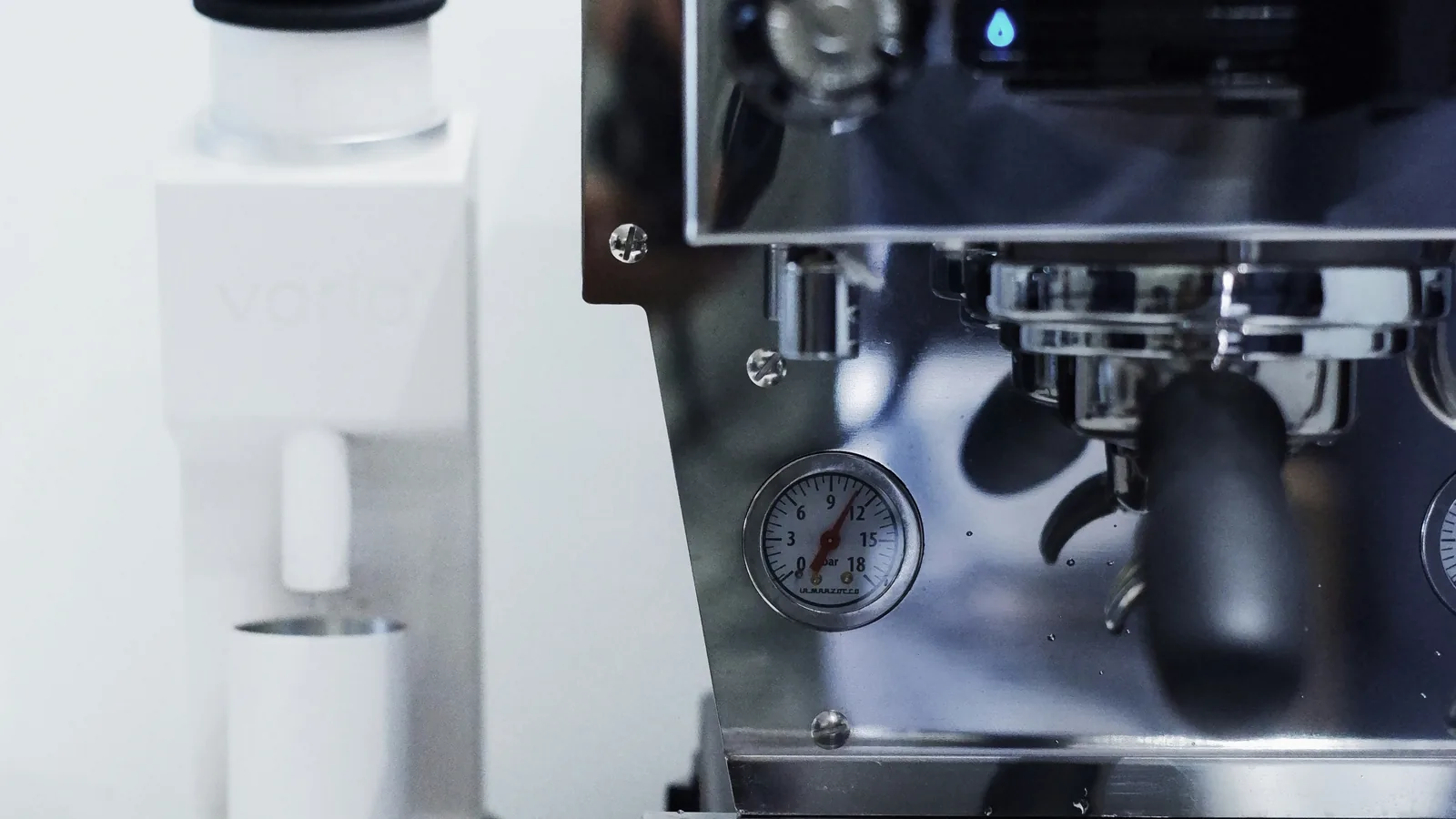
My current setup is built around that idea. I now use a Sage Dual Boiler and a Varia VS6 grinder. For the grinder, I also bought the optional Supernova Gold flat burrs and the conical burr set, because apparently owning one perfectly good burr geometry would have made life too easy.
The different burrs let me change the character of the coffee. Broadly speaking, the flat burrs can emphasize clarity and separation between flavours, while the conical burrs tend to produce a rounder, more traditional espresso with greater body. Having both gives me room to experiment, but the real luxury of the setup is not the number of variables available to me. It is how easily I can get a great result without turning the kitchen into a coffee laboratory every morning.
The Dual Boiler offers the temperature stability and control needed for excellent espresso, while allowing me to steam milk at the same time. The VS6 is fast, capable and pleasantly straightforward to use. After spending years adding tools and steps, I have started to appreciate equipment that quietly removes friction.
That preference also explains my most recent addition: the Fellow Aiden. I still enjoy pour-over and batch filter coffee, especially when I want a larger, slower drink rather than an espresso, but I do not always enjoy the time and attention manual pour-over requires. The Aiden automates the water temperature, timing and pouring pattern, producing remarkably good filter coffee with very little intervention.
Purists may argue that this removes some of the ritual. They are right. That is precisely the point.
A very long journey for a very short drink
My relationship with coffee has changed quite a bit since those first university espressos. It started as a tool to compensate for poor planning, became a connection with my grandmother, turned into a full-blown hobby, and eventually taught me far more than I expected about taste, technique and the dangerous economics of marginal gains.
It also mirrors a pattern that appears in many of my interests. First, I discover that something can be improved. Then I descend into the rabbit hole, learn every variable, acquire an unreasonable number of accessories, and optimize the process until I finally arrive back at simplicity—albeit a much more expensive version of it.
I still love experimenting with new beans, changing burrs and chasing the occasional exceptional shot. But these days I also appreciate pressing a button and receiving an excellent batch brew, or making a cappuccino without treating it as a competitive sport. The equipment has become more sophisticated, but the goal has become simpler: coffee that tastes great, made in a way that fits naturally into my day.
And if it happens to have a decent tulip on top, even better.